

Vending Operators7 min read
On this page
Vending route management for growing fleets is the set of systems, from restocking schedules to telemetry to location agreements, that let an operator add machines and drivers without losing track of any single stop. A route that works fine with 8 machines and one driver breaks down fast at 40 machines and three drivers unless the underlying systems scale with it. The difference between a fleet that grows smoothly in 2026 and one that stalls out is almost always process, not product mix.
TL;DR- Vending route management for growing fleets depends on documented restocking cadence, telemetry, and location scoring, not memory.
- Manual spreadsheet tracking works until roughly the point a second driver is added, then reconciliation errors multiply.
- Location agreements and separate business banking become operational necessities, not paperwork, once multiple people touch cash and inventory.
- The IRS recommends keeping business records for three years after filing, a baseline every growing fleet needs to plan around.
Why route management systems matter as your fleet grows
A single-operator route with 8 to 10 machines can run on a notebook and a good memory. Once a fleet crosses into multiple drivers, multiple service days, and machines spread across several ZIP codes, informal tracking starts costing money in the form of missed restocks, duplicated drive time, and cash that doesn't reconcile at the end of the week.
Growing fleets also face a different set of decisions than single-route operators: Which locations to keep, which to cut, whether to add a driver or reroute an existing one, and how to keep multiple people accountable for the same cash box. Vending route management for growing fleets is largely about making those decisions with data instead of guesswork. The The Vending Club directory lists operator tools and templates that many operators use as a starting point before building custom systems.
None of the systems below require a large budget to start. Spreadsheets and paper logs get an operator through the first stage of growth. The point where telemetry, formal agreements, and separate accounting stop being optional is usually the point where a second or third driver joins the operation.
Map your current route structure
Before adding systems, get an accurate picture of what already exists. Many growing fleets are running routes that were built ad hoc, one location at a time, and never resequenced.
- List every machine by address, product category, and current service frequency
- Group machines by geographic cluster rather than by the order they were added
- Flag any location visited more often than its sales justify
- Note travel time between stops on each route, not just stop count
- Identify machines that could move to a different driver's route without adding mileage
Standardize your restocking cadence
An inconsistent restocking schedule is one of the first things to break down as a fleet grows, because a driver who used to service five machines from memory can't do the same for twenty five spread across three routes.
- Set a fixed visit day or window for each location and put it in writing
- Base frequency on sales velocity per machine, not a blanket calendar
- Track last-service date per machine somewhere everyone on the team can see
- Flag any location that's gone longer than its normal interval without a visit
- Build a simple restock checklist so any driver, not just the route owner, can service any stop
Adopt telemetry before routes get overwhelmed
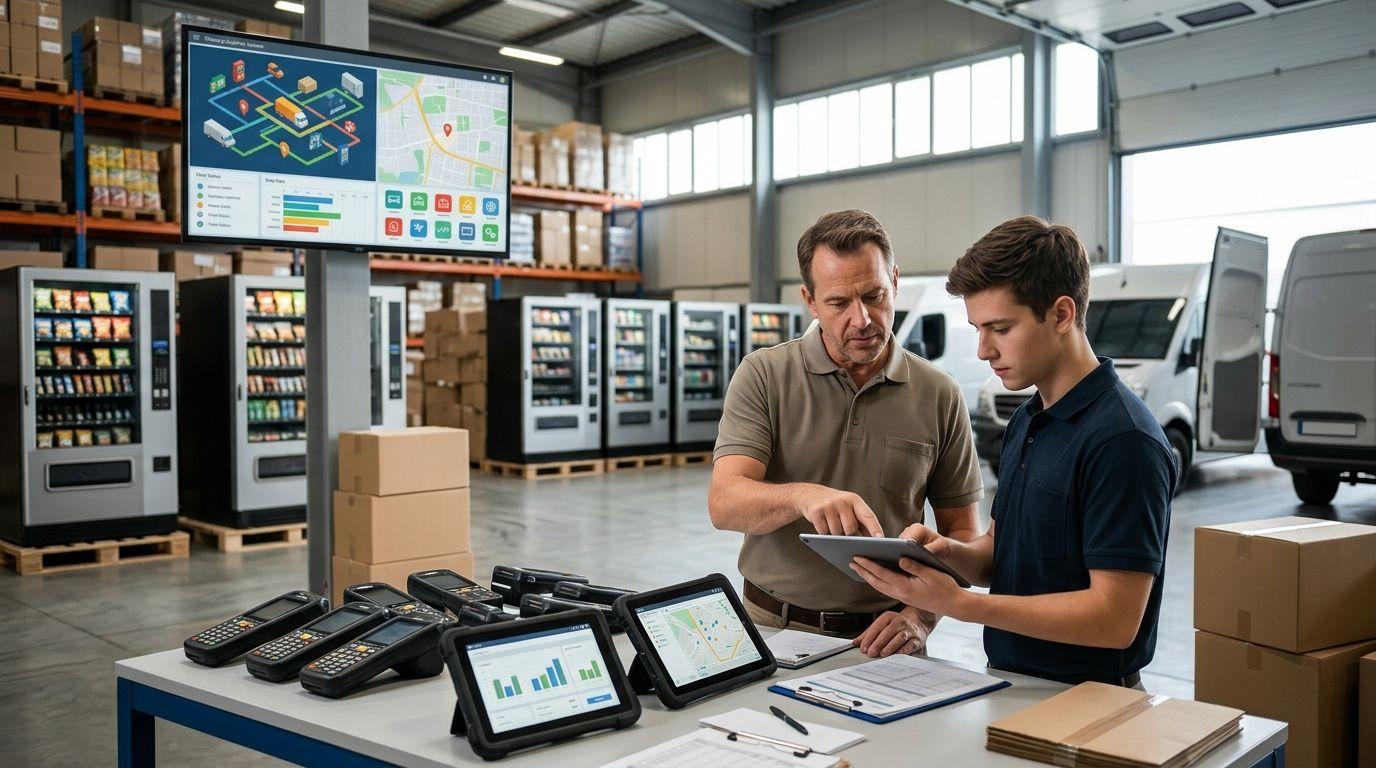
Manual route management works until a driver is making decisions blind, driving to a machine that didn't need service or missing one that ran empty for days. Telemetry and remote monitoring systems report sales, temperature, and stock levels without a physical visit, and a comparison of telemetry and remote monitoring systems is a reasonable place to start narrowing options, keeping in mind other providers exist beyond any single comparison.
- Confirm the system reports stock levels per product slot, not just total sales
- Check whether alerts trigger for temperature swings on refrigerated or frozen units
- Ask whether the platform integrates with the cashless readers already installed
- Review how much historical data the dashboard retains for trend analysis
- Confirm whether the system requires a data plan per machine or a flat fleet fee
Centralize cash and card reconciliation
Once more than one person is collecting cash or reconciling card batches, informal tracking creates gaps that are hard to trace after the fact. A growing fleet needs one system of record for money, even if drivers still count cash by hand at each stop.
- Require a per-visit cash count logged at the machine, not estimated later
- Reconcile card transaction reports against bank deposits on a fixed schedule
- Assign one person, not every driver, to reconcile totals across the fleet
- Flag any location where reported sales and collected cash don't match
- Keep transaction records for at least three years; the IRS recommends this window for most business records after a return is filed
Score each location on profit, not just sales
A location with high sales volume isn't automatically a good stop if it also requires frequent, low-efficiency visits. Growing fleets that don't formally score locations tend to keep underperforming stops out of habit.
- Calculate net revenue per visit, factoring in drive time and restock labor
- Compare each location's revenue per square foot of machine footprint
- Track how often a location's sales trend up or down quarter over quarter
- Rank routes, not just machines, by total profitability per driver-hour
- Flag any location below the fleet's average for review before renewal
Put location agreements in writing
Handshake placements are common at the single-machine stage and increasingly risky as a fleet grows and more stakeholders, property managers, facility staff, competing vendors, get involved. A written agreement documents commission terms, service responsibilities, and what happens if either party wants out.
- Specify exclusivity terms so another vendor can't place a competing machine
- Document commission structure and payment schedule in the agreement itself
- Include a defined notice period for either party to end the arrangement
- Address what happens to the machine and inventory if the location closes
- Keep signed copies accessible to whichever driver services that stop
Separate your business banking from day one
As cash volume grows across multiple machines and drivers, mixing personal and business funds makes reconciliation harder and can weaken the liability protection an LLC or corporation is meant to provide. The U.S. Small Business Administration recommends opening a dedicated business account as part of formally launching and operating a business.
- Open a business account before adding a second driver or route
- Route all cash deposits and card settlement deposits into that one account
- Use the account statement as a cross-check against manual cash logs
- Keep a separate ledger for equipment purchases versus operating expenses
- Review whether the current setup still works as machine count doubles
Choosing a route management approach
There's no single system that fits every fleet size, and the right approach usually changes as machine count grows. The comparison below covers general categories rather than named products; other approaches and providers exist beyond what's listed here.
| Approach | Suited to | Key limitation |
|---|---|---|
| Spreadsheet or paper log | Single-route operators with fewer than 15 machines | Breaks down once more than one person needs to log data in real time |
| Route accounting software | Fleets adding a second or third driver | Requires consistent data entry discipline to stay accurate |
| Telemetry-enabled monitoring | Fleets managing machines across multiple ZIP codes | Adds a recurring data or subscription cost per machine |
| Third-party route management service | Operators who want day-to-day route logistics handled externally | Reduces direct control over scheduling and driver relationships |
Compare telemetry options for your fleet
Review the telemetry and remote monitoring roundup before adding your next route.
Read the route valuation guideCommon mistakes growing fleets make
- Keeping the original route sequence after adding machines. A route built for 8 stops rarely stays efficient once it's grown to 20, but many operators never resequence it.
- Waiting until routes are unmanageable to adopt telemetry. By the time driving blind becomes obviously costly, a fleet has usually already lost revenue to missed restocks.
- Treating every location the same. A high-traffic location that requires three visits a week isn't automatically better than a lower-traffic one that only needs one.
- Leaving location agreements verbal as headcount grows. More drivers and more stakeholders touching the same location increases the odds a handshake deal falls apart.
- Mixing personal and business accounts once multiple people handle cash. This is manageable with one driver and unworkable with three.
One last thing
The systems that matter most for vending route management for growing fleets are rarely the flashiest ones. A written restocking cadence and an accurate location list catch more problems day to day than a telemetry dashboard nobody checks. Build the basic paperwork first in 2026, then layer telemetry and third-party services on top once the fleet's size actually justifies the added cost.
Sources
- Internal Revenue Service, "How long should I keep records?" (2026): https://www.irs.gov/businesses/small-businesses-self-employed/how-long-should-i-keep-records
- U.S. Small Business Administration, "Open a business bank account" (2026): https://www.sba.gov/business-guide/launch-your-business/open-business-bank-account
Get new vending guides in your inbox
The Vending Club publishes new operator guides most days. The free General Updates newsletter goes out every Friday with the week's new articles, and nothing else. You choose the updates you want, we confirm by email before sending anything, and you can unsubscribe at any time.
Related guides
Common questions
- How do you decide when a vending route needs a second driver?
A second driver typically becomes necessary when total drive time and service time for existing stops exceeds what one person can complete on schedule. Track total route hours per week before deciding, rather than relying on machine count alone.
- How do you choose between spreadsheet tracking and telemetry for a growing fleet?
Spreadsheet tracking is workable for a single route under roughly 15 machines managed by one person. Once multiple drivers or locations spread across a wider area are involved, telemetry reduces the guesswork that manual logs can't catch in real time.
- How much downtime is normal for a vending machine each month?
Downtime varies by machine type, location traffic, and service frequency. A dedicated breakdown of typical vending machine downtime is available for operators comparing their own numbers against general patterns.
- How do you keep vending machine location agreements enforceable as you add sites?
Put commission terms, exclusivity, service responsibilities, and a notice period in a written agreement signed by both parties. Verbal arrangements become harder to enforce as more staff and stakeholders are involved at each site.
- Do vending machine owners need a separate business bank account?
A separate business account isn't legally required in every state, but the SBA recommends it to preserve liability protections and simplify reconciliation. It becomes more important once more than one person is handling cash across multiple machines.
- How do you track vending machine restocking across multiple routes?
Log last-service date and current stock level per machine somewhere the whole team can access, not just the route owner. A shared restock checklist lets any available driver service any stop without missing a step.
- How do you choose a route management approach for a growing fleet?
Match the approach to current machine count and driver count rather than projected growth. Spreadsheets suit small single-route operations, while telemetry and route software suit fleets spanning multiple drivers and service areas.
- How do you evaluate whether a vending location is still profitable?
Calculate net revenue per visit after factoring in drive time and restock labor, then compare that figure against the fleet average. A location with high total sales but heavy service demands can still underperform a quieter, lower-maintenance stop.