

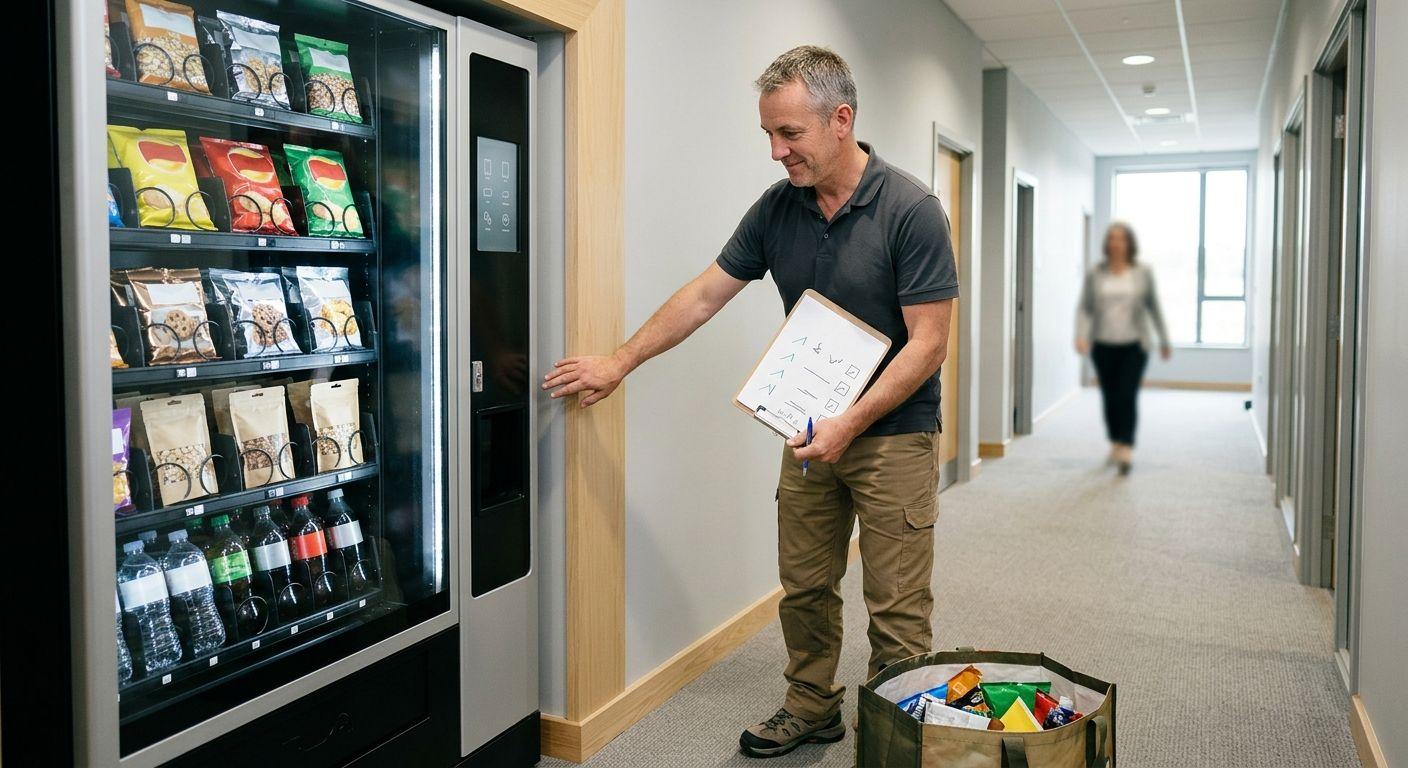
Vending Operators7 min read
On this page
Buying an existing vending route in 2026 can shortcut the slow work of placing machines one location at a time, but the value of that shortcut depends entirely on what actually transfers with the sale: Verified sales records, equipment in working condition, and location agreements that survive a change of ownership. A route that looks profitable on paper can lose a third of its stops within months if those agreements were informal handshake deals tied to the outgoing operator, not transferable contracts.
TL;DR- Buying a vending route in 2026 pays off when sales records, equipment condition, and location agreements are all verifiable before closing.
- Handshake location agreements often don't transfer to a new owner, even when the route's monthly numbers look solid.
- Equipment age and cashless payment technology matter as much as revenue, since aging machines raise repair costs right after the sale.
- A free vending industry directory and record-request templates help buyers check paperwork and compare agreement terms before committing.
Why this matters
The U.S. Small Business Administration lists buying an existing business as one of the standard paths into an industry, alongside starting from scratch or buying a franchise, because it can skip the slowest part of building operations: Finding customers (U.S. Small Business Administration, "Buy an Existing Business"). Vending is no different. A route with placed machines and active accounts is, in theory, a business already generating cash flow the day you take ownership.
The catch is that "in theory" is doing a lot of work in that sentence. Vending routes are sold with wide variation in how well-documented they are, and a seller's asking price rarely reflects how much of that route will still exist six months after the transfer. Anyone considering buying a vending route in 2026 needs a way to separate a documented, transferable business from a pile of machines with a story attached.
Is buying an existing vending route worth it in 2026?
Buying an existing vending route in 2026 is worth it when the seller can produce verifiable sales history, current service records for each machine, and location agreements (or at minimum, clear evidence of a working relationship with each site) that will hold after ownership changes hands. It is not worth it when the only proof of performance is the seller's word, because a route's real value lives in whether its accounts and machines transfer intact, not in what a spreadsheet claims.
The comparison below lays out how buying a route stacks up against building one, location by location, from zero. Other paths into vending exist too, including buying a franchise or partnering with an existing operator, so treat this as a starting comparison rather than the only two options.
| Factor | Buying an existing route | Building a route from scratch |
|---|---|---|
| Time to first cash flow | Can be immediate if locations transfer cleanly | Typically months, while you place machines and build accounts |
| Verified sales history | Available if the seller provides real records | None; you're working from projections |
| Location control | Depends on whether site agreements transfer | Full control since you choose every site |
| Equipment condition risk | Unknown until independently inspected | Generally known, especially with new equipment |
| Upfront capital | Route price plus inspection and legal review costs | Equipment cost plus the time cost of finding locations |
| Typically suited to | Buyers who can verify records and inspect equipment before closing | Operators who want to set service standards and site selection from day one |
Neither path is inherently the stronger move. A verified, well-documented route can save a year of prospecting. An unverified one can cost more in cleanup and re-placement than starting fresh would have.
Why vending route prices and quality vary
Route listings for sale in 2026 span a wide range of condition and documentation quality, and price alone tells you almost nothing about which bucket a specific route falls into. A few factors drive most of that variation:
- Location mix and foot traffic. A route serving a handful of high-traffic offices differs completely from one spread across low-traffic sites that happen to have a machine parked there.
- Equipment age and payment technology. Machines with working cashless readers and telemetry cost less to service and report sales more reliably than older coin-only units.
- Documented sales history vs. seller estimates. Bank deposits, telemetry reports, or DEX data are verifiable; a seller's verbal revenue figure is not.
- Contract transferability. A route built on signed, assignable location agreements is a different asset than one built on personal relationships between the outgoing operator and site managers.
- Product category. Snack and beverage routes, bulk vending routes, and micro market accounts have different service intervals, margins, and buyer pools.
- Service and restocking logistics. A geographically tight route is cheaper to service than one scattered across a wide radius, which affects what the route is realistically worth to a new owner.
“A route without a signed location agreement is inventory, not income.”
How do you evaluate a vending route before buying it in 2026?
Due diligence on a vending route follows a fairly consistent sequence, regardless of how many machines or locations are involved.
- Request sales and service records for every machine. Bank deposits, telemetry reports, or DEX data carry more weight than a seller's summary sheet. A checklist of records to request when buying used vending equipment gives you a starting list of what to ask for before you make an offer.
- Verify each location individually, not the route as a whole. A route's total revenue can hide the fact that three of ten locations are marginal or about to close. Steps to verify a proposed vending location apply just as directly when the location already has a machine on it as when it's brand new to you.
- Inspect the equipment in person. Check compressor function on refrigerated units, coin mechanism and bill validator condition, and whether cashless readers are functioning and current on firmware.
- Confirm which agreements transfer, in writing. Ask the seller directly whether location agreements are assignable, and get site manager confirmation where possible rather than relying on the seller's assurance.
- Check the tax and licensing status of the route. Sales tax registration, business licenses, and any health department permits tied to the current operator generally don't transfer automatically and need to be re-established under the new owner.
- Put the terms in a written purchase agreement. Verbal understandings about what's included (machines, contracts, inventory, non-compete terms) create disputes later if they're not documented.
Check the paperwork before you buy
Free record-request checklists and agreement templates for vending buyers.
Read the route valuation guideRelated questions about buying a vending route
How do you verify a vending route's sales figures before buying it?
Verify a route's sales figures using bank deposit records, telemetry or DEX reports, or point-of-sale statements tied directly to the machines being sold, not a seller-provided summary. Cross-check a sample of months against the physical machine's coin and bill counts where possible, since discrepancies between reported and counted sales are one of the more common issues buyers run into during route due diligence.
What paperwork should transfer with a vending route?
The paperwork that should transfer with a vending route includes signed location agreements, current equipment service records, any warranty documentation, and a clear bill of sale listing every machine by serial number. How ownership of a specific site actually moves from one operator to another is covered in more detail in how a vending machine location transfers to a new owner, which is worth reviewing before you assume a handshake deal will hold.
Can you finance the purchase of an existing vending route?
Financing an existing vending route purchase is possible through several channels, including small business loans, equipment-based financing, and in some cases seller financing negotiated directly into the purchase agreement. Lenders typically want to see the same verified sales and service records a careful buyer would request anyway, which is one more reason documentation matters before you make an offer.
One last thing
Accessibility rules don't disappear just because a vending machine changes hands. The 2010 ADA Standards for Accessible Design set reach-range and operability requirements for vending machines in public buildings, and those obligations apply to whoever operates the machine in that location, not just whoever installed it originally (U.S. Department of Justice, "2010 ADA Standards for Accessible Design"). If a route you're evaluating includes machines in government buildings, schools, or other public facilities, confirm the machines meet current placement and reach requirements before you assume the existing setup is compliant. On the equipment side, the IRS allows businesses to depreciate qualifying property, including used equipment acquired during the tax year, under the rules in IRS Publication 946, which is worth reading before you assume a used route's equipment carries the same tax treatment as new machines.
Get new vending guides in your inbox
The Vending Club publishes new operator guides most days. The free General Updates newsletter goes out every Friday with the week's new articles, and nothing else. You choose the updates you want, we confirm by email before sending anything, and you can unsubscribe at any time.
Related guides
- How a vending machine location transfers to a new owner
- What a full-service vending agreement should include
Sources
- U.S. Small Business Administration, "Buy an Existing Business": https://www.sba.gov/business-guide/plan-your-business/buy-existing-business
- U.S. Department of Justice, "2010 ADA Standards for Accessible Design": https://www.ada.gov/law-and-regs/design-standards/2010-stds/
- Internal Revenue Service, "Publication 946, How To Depreciate Property": https://www.irs.gov/publications/p946
Common questions
- How do you choose between buying an existing vending route and starting a new one?
Choosing between buying and building comes down to whether the route's sales records, equipment condition, and location agreements can be independently verified. If they can't be verified, building a new route with machines you place yourself removes that uncertainty, even though it takes longer to reach steady cash flow.
- Is buying a vending route worth it in 2026?
Buying a vending route in 2026 is worth it when the seller provides verifiable sales history, current equipment service records, and location agreements that transfer with the sale. Without that documentation, the purchase price reflects a story about the route, not a confirmed one.
- How do you verify a vending route's sales numbers before buying it?
Verify sales numbers using bank deposits, telemetry or DEX data, or point-of-sale reports tied to the specific machines being sold, then compare a sample against physical coin and bill counts where you can. A seller's verbal revenue estimate on its own isn't verification.
- Do vending machine locations automatically transfer to a new owner?
No, vending machine locations do not automatically transfer to a new owner in most cases. Many placement arrangements are informal agreements between the site manager and the outgoing operator, so a new owner needs to confirm and often re-establish each relationship directly.
- What should be included in a vending route purchase agreement?
A vending route purchase agreement should list every machine by serial number, specify which location agreements and contracts transfer, disclose any known equipment issues, and set terms for inventory, warranties, and non-compete restrictions on the seller.
- How do you finance an existing vending route purchase?
Financing an existing vending route purchase typically comes through small business loans, equipment financing, or seller financing built into the purchase terms. Lenders generally require the same verified sales and service records a cautious buyer should be reviewing anyway.
- What equipment records should a vending route seller provide?
A vending route seller should provide maintenance logs, repair history, warranty documentation, and the age and model information for each machine included in the sale. Missing service records on refrigerated or cashless-enabled units are a common warning sign during due diligence.