

Vending Operators7 min read
On this page
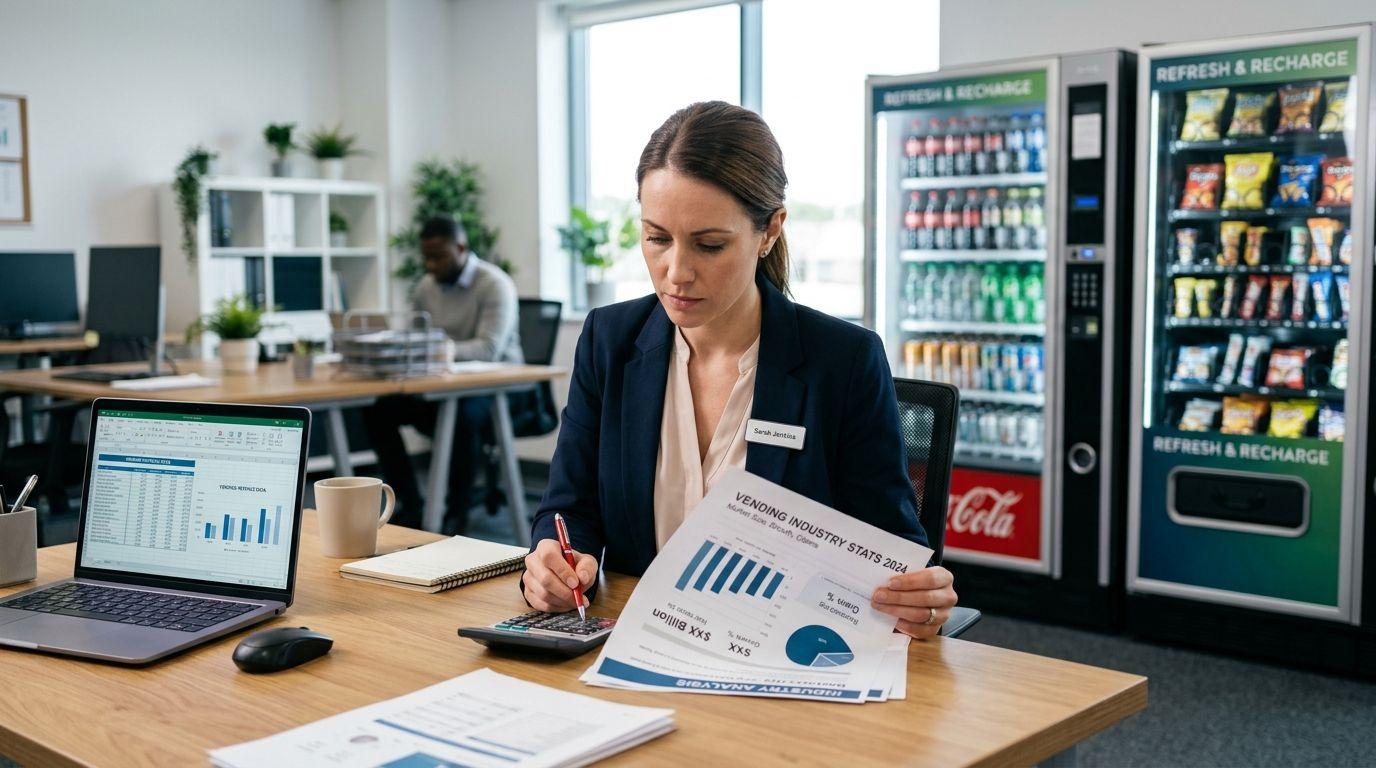
Verifying a vending industry statistic means tracing it back to a named source, government data, a trade association report, or a company's own filed numbers, before you repeat it in a pitch deck, a loan application, or a contract negotiation. To verify vending industry statistics, check whether the number comes from a primary source (the agency or association that collected it) or a secondary one (a blog, a sales page, a recycled press release), then cross-check it against at least one independent source before you use it.
TL;DR- To verify vending industry statistics, trace every number to a named source: A government agency, a trade association, or filed company data.
- The National Automatic Merchandising Association (NAMA) and the U.S. Census Bureau publish the closest thing to authoritative vending data available.
- NAICS code 454210 (Vending Machine Operators) is the federal classification the Census Bureau and Bureau of Labor Statistics use to track this industry.
- A single-source statistic in a sales brochure or franchise pitch is a red flag until it's confirmed against a government or trade source.
- State-level claims about tax rates or licensing fees need a state Department of Revenue citation, not a national average.
Why This Matters
Vending is a fragmented industry: Thousands of independent single-route operators run alongside a small number of national companies, and no single business's numbers represent the whole market. That fragmentation is exactly why unverified statistics travel so far, a supplier's internal uptime figure or a franchise seller's revenue projection gets repeated in blog posts and investor decks until it reads like an industry standard.
The vending industry directory and tools on The Vending Club exist partly to give operators a neutral starting point instead of a vendor's own marketing page. But the directory doesn't replace the verification step, it points you toward primary sources; you still have to check the date, the scope, and the methodology behind any number before you cite it in 2026.
How Do You Verify Vending Industry Claims and Statistics?
Work through these steps in order. Most claims fall apart or hold up within the first two or three:
- Identify the exact claim and its stated source. If a statistic doesn't name an agency, association, or study, treat it as unverified.
- Check whether the source is primary or secondary. A government agency or trade association that collected the data is primary. A blog, listicle, or press release repeating someone else's number is secondary and needs to be traced further back.
- Cross-check against a second, independent source. A supplier's own uptime claim should be checked against telemetry data, a third-party audit, or an operator's own logs, not just repeated as-is.
- Check the publication date. Vending payment technology and consumer spending patterns shift fast; a statistic more than three to five years old should be flagged as dated, not cited as current.
- Confirm the claim matches your segment and geography. A national average for vending machine revenue does not describe a single-state market, and a snack vending figure doesn't describe frozen food or ice vending economics.
| Claim type | Where to check first | Red flag |
|---|---|---|
| Market size / revenue | U.S. Census Bureau, NAMA | Number with no year attached |
| Machine uptime / reliability | Telemetry data, operator logs | Vendor-only source, no third party |
| Tax or licensing rule | State Department of Revenue, IRS | "Most states" without naming which |
| Franchise or business opportunity ROI | FTC Franchise Rule disclosures | Projected earnings with no disclosure document |
Verifying Market Size and Revenue Claims
Market size and average revenue-per-machine claims are the most commonly recycled numbers in vending sales materials, and they're also the hardest to verify because there's no mandatory federal reporting specific to vending machine sales. The Census Bureau's Economic Census, which runs on a five-year cycle, is the closest thing to a primary government count of the industry, supplemented by the Bureau of Labor Statistics' employment and wage data for the sector.
When you see a market size figure in an industry article or a sales deck, ask: Is this from the Economic Census, from a paid research firm's report, or from a trade association survey? Each has a different sample size and methodology, and none of them update in real time. A number pulled from the last published Economic Census cycle can already be a few years old by the time it appears in a 2026 sales pitch.
Verifying Machine Count, Location, and Uptime Claims
Suppliers and equipment sellers routinely publish uptime, reliability, or revenue-per-location figures in their own marketing. These are proprietary claims, not independent measurements, and they should be treated that way until confirmed. Ask the vendor for the underlying telemetry data or a third-party service log behind any uptime percentage.
Operators comparing their own machine performance against an industry claim can check what counts as normal downtime for a vending machine each month as a starting reference point, then verify any specific product claim against their own service records rather than accepting a vendor's number at face value. Remote monitoring and telemetry systems generate machine-level data that's far more verifiable than a marketing brochure's aggregate figure, because it's tied to a specific machine, location, and time period.
Verifying Tax, Legal, and Regulatory Claims
Tax and licensing claims are the category where an unverified statistic causes the most direct financial harm, because they show up in filings, not just conversations. A claim about depreciation, a deduction rule, or a state sales tax rate on vended goods needs a citation to the Internal Revenue Service or the relevant state Department of Revenue, not a general statement about "most states" or "typical operators."
Rules vary by state and by product category (food versus non-food, for example), so a national rule of thumb rarely applies cleanly everywhere. Franchise or business opportunity earnings claims fall under the Federal Trade Commission's Franchise Rule, which requires specific disclosure documents; a projected revenue figure with no disclosure attached is not a verified claim, it's a sales projection.
“A single-source statistic in a sales pitch is a claim, not data.”
Why Vending Industry Statistics Vary
A handful of structural reasons explain why the same "fact" about the vending industry shows up with different numbers depending on where you read it:
- No mandatory vending-specific federal reporting. Data gets estimated from broader retail trade categories or sampled through the Economic Census, not collected as a standalone vending report every year.
- Fragmented ownership. Thousands of small, independent single-route operators exist alongside a small number of larger regional and national operators, so no single company's internal data represents the market.
- Vendor and sales incentives. Equipment sellers, franchise sellers, and route sellers have a financial reason to publish favorable uptime, ROI, or revenue-per-machine figures.
- State and local variation. Licensing requirements and sales tax treatment of vended goods differ by state, so a national average often hides a wide range underneath it.
- Recycled, undated statistics. Trade press and blog content frequently repeat older numbers without a publication date attached, so a stat can circulate long after it stops being accurate.
Is the National Automatic Merchandising Association (NAMA) a Reliable Source for Vending Statistics?
NAMA is the trade association for the U.S. vending, micro market, and coffee service industry, and it publishes association-level industry information as part of its role representing member companies. Trade association data is useful context, but it comes from an organization that also advocates for its members' interests, so it's worth cross-checking association figures against a government source like the Census Bureau or Bureau of Labor Statistics when a specific number matters to a financial decision.
What NAICS Code Do Vending Machine Operators Use for Federal Data?
Vending Machine Operators are classified under NAICS code 454210, the code the U.S. Census Bureau and the Bureau of Labor Statistics use to track employment, establishment counts, and other federal statistics for the industry. If you're trying to verify a claim that cites "government data" on vending, checking whether it's pulled from the 454210 classification is a fast way to confirm it's tied to a real federal data series rather than a vendor's own estimate.
How Often Does the U.S. Census Bureau Update Vending Industry Data?
The Economic Census, the Census Bureau's most comprehensive industry data collection, runs on a five-year cycle covering years ending in 2 and 7. Between Economic Census years, narrower surveys like County Business Patterns provide annual updates on establishment counts and employment, though with less granular detail than the full Economic Census. A vending statistic that cites "Census data" without specifying which survey and which year is harder to verify and should be checked against the Census Bureau's published release directly.
One Last Thing
The Economic Census, the most comprehensive federal data source on the vending industry, only runs every five years and its full results are typically published with a lag of a year or more after collection. That means the "latest government data" on vending at any given moment in 2026 could already describe conditions from several years earlier, which is exactly why a publication date matters as much as the number itself when you're deciding whether a statistic is still useful.
Cross-check claims before you sign
Use the operator tools and state guides to verify data yourself.
Browse state guidesRelated Guides
- Can you write off a vending machine purchase on your taxes
- Do vending machine owners need a separate business bank account
- Vending machine telemetry and remote monitoring systems
Get new vending guides in your inbox
The Vending Club publishes new operator guides most days. The free General Updates newsletter goes out every Friday with the week's new articles, and nothing else. You choose the updates you want, we confirm by email before sending anything, and you can unsubscribe at any time.
Sources
- National Automatic Merchandising Association (NAMA), homepage: https://www.namanow.org/
- U.S. Census Bureau, homepage: https://www.census.gov/
- U.S. Bureau of Labor Statistics, homepage: https://www.bls.gov/
- Federal Trade Commission, homepage: https://www.ftc.gov/
- Internal Revenue Service, homepage: https://www.irs.gov/
Common questions
- How do you verify a vending machine revenue statistic before citing it?
Trace the statistic to its original source, government data, a trade association report, or filed company data, then confirm the publication date and whether it applies to your machine type and geography. A revenue figure with no named source or date should not be treated as verified.
- How do you check if a vending industry claim is outdated?
Check the publication date on the original source; vending payment technology and consumer spending patterns shift quickly enough that a statistic more than three to five years old should be flagged as dated rather than cited as current for 2026.
- Is IBISWorld a reliable source for vending machine industry data?
IBISWorld is a paid market research firm that publishes industry reports, including on vending machine operators, using its own analyst methodology. It's one input worth cross-checking against government sources like the U.S. Census Bureau rather than treating as the sole authority on a market figure.
- How do you confirm a vending machine tax deduction rule for your state?
Check the Internal Revenue Service's published guidance for federal deductions and your state Department of Revenue's own site for state-specific rules, since sales tax treatment of vended goods and equipment deductions vary by state and are not covered by a single national rule.
- How do you verify vending machine downtime claims from a supplier?
Ask the supplier for the underlying telemetry or service log data behind any downtime or uptime percentage rather than accepting the marketed figure, and compare it against your own machine's service records over a comparable time period.
- What government agency tracks vending machine operator employment data?
The U.S. Bureau of Labor Statistics tracks employment and wage data for Vending Machine Operators under NAICS code 454210, alongside the U.S. Census Bureau's establishment counts collected through the Economic Census and County Business Patterns surveys.
- How do you tell if a vending industry statistic is from a biased source?
Check who published the number and what they sell; a trade association, equipment vendor, or franchise seller has an interest in favorable figures, so their statistics are worth cross-checking against a government source like the Census Bureau or BLS before you rely on them.