

Vending Operators7 min read
On this page
Workplace vending machines, micro markets, and pantry (break room) service are three different ways to put snacks, drinks, or food access in front of employees, and the right one depends on headcount, budget, space, and how much oversight your team can put into food safety and restocking. A vending machine fits a smaller footprint with lower staffing needs. A micro market fits a larger, higher-traffic space where employees want more variety and 24/7 self-checkout. Pantry service fits an employer that wants to subsidize or fully cover the cost as a perk rather than run a coin-op or self-checkout setup.
TL;DR- Workplace vending vs micro market vs pantry service comes down to headcount, space, and who pays: Vending machines fit smaller offices, micro markets fit larger ones with self-checkout, pantry service is an employer-subsidized perk.
- Micro markets use open shelving and a checkout kiosk or app instead of a coin-op machine, which changes food safety and loss-prevention responsibilities.
- Vending equipment purchases may qualify for depreciation or Section 179 treatment under IRS rules, which is a separate question from which service model fits your office.
- No single model is objectively better; other hybrid setups and regional providers exist beyond the three covered here.
Why This Matters
Picking the wrong model wastes money either way. A vending machine in a 400-person office with heavy foot traffic runs out of stock fast and frustrates employees who want more variety than a machine's limited slots allow. A micro market in a 10-person office sits underused, and the fixed costs of the kiosk and open shelving don't make sense for that little traffic.
Pantry service changes the math entirely because the employer is paying for the product instead of employees, which shifts the decision from "what generates revenue for an operator" to "what fits our benefits budget." Understanding how each model actually works, not just what it's called, is what makes the choice easier in 2026.
Workplace Vending, Micro Market, or Pantry Service: How Do You Choose?
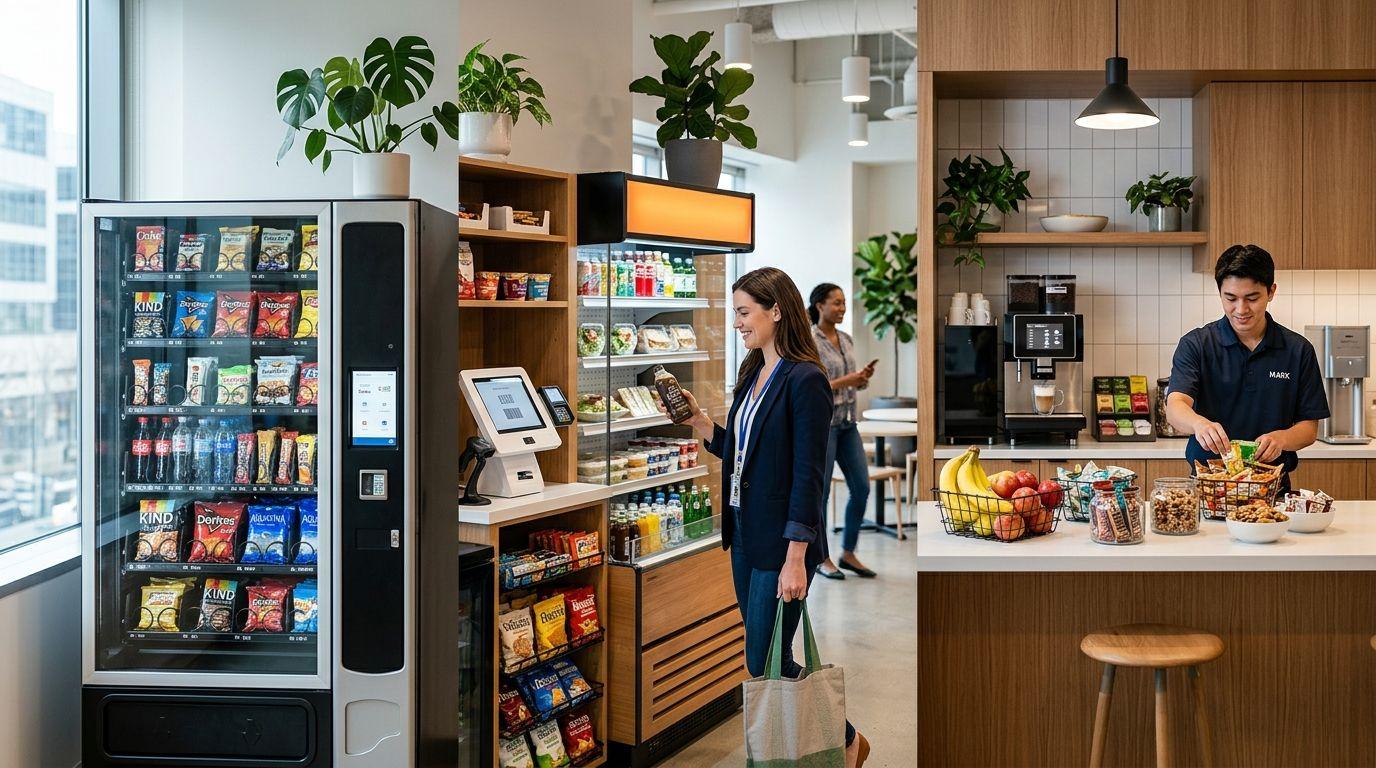
Start with three questions: How many people will use it daily, how much unmonitored space can you dedicate, and who is paying for the product. The table below lays out how each model handles access, restocking, and food safety oversight.
| Model | How Access Works | Restocking & Staffing | Food Safety Oversight | Typical Fit |
|---|---|---|---|---|
| Vending machines | Coin, card, or mobile payment at a machine | Operator restocks on a set route schedule | State/local vending machine sanitation codes apply | Smaller offices or spaces with limited room for open shelving |
| Micro markets | Open shelving and coolers, self-checkout kiosk or app, often 24/7 access | Restocked more frequently, wider SKU count, needs stronger loss-prevention | Regulated similarly to small self-service retail food establishments under state adoption of the FDA Food Code | Larger offices with steady foot traffic and enough trust for an unmonitored, self-checkout setup |
| Pantry/break room service | Free or subsidized items placed directly on break room shelves, no payment step | Restocked by the employer, in-house staff, or a refreshment service | Employer handles on-site food storage practices directly | Employers offering a subsidized or fully covered perk instead of a revenue-generating vending service |
Other hybrid arrangements exist too, including partial-subsidy micro markets or vending programs that mix free items with paid ones, so treat this as a starting framework rather than the only three options on the market.
Workplace Vending Machines: How They Work
A workplace vending machine dispenses packaged snacks, drinks, or in some cases frozen or hot food from a fixed set of slots. An operator services the The Vending Club member directory area for a given metro and restocks the machine on a route, usually weekly or biweekly depending on volume.
The upside is a small footprint and low staffing burden for the employer. A 10-to-40-person office can run a single combo machine (snacks and drinks together) without dedicating more than a few square feet.
The downside is limited variety and slot capacity. If daily traffic climbs past what a machine can hold between restocks, employees hit sold-out slots regularly, and that's usually the signal it's time to look at a micro market instead. Offices evaluating operators for this setup often start from resources on companies that service office break rooms to compare what different providers offer before signing a placement agreement.
Micro Markets: How They Work
A micro market replaces the machine with open shelving, coolers, and a self-checkout kiosk or mobile app. Employees browse like a small convenience store, scan or select items, and pay without a cashier present.
That open format supports far more SKUs than a vending machine's fixed slots, which is why micro markets tend to fit larger, higher-traffic locations, think a 150-employee floor rather than a 10-person office. Access is frequently available around the clock rather than tied to a route schedule.
The tradeoff is exposure. Because product sits on open shelves instead of behind a locked machine, loss prevention and restocking frequency both increase compared to a vending machine. Most state and local health departments base retail food establishment rules, which can apply to self-service micro market setups, on the FDA Food Code (FDA, 2022).
Pantry (Break Room) Service: How It Works
Pantry service, sometimes called break room refreshment service, removes the payment step entirely. The employer buys the product, either directly or through a subsidized refreshment provider, and stocks it on break room shelves as a free or discounted employee perk.
This model is a benefits decision, not a vending decision. There's no coin-op machine, no kiosk, and no operator commission structure to negotiate, because the employer is the buyer instead of the employee. It's a fit for companies treating snacks and drinks as part of the overall benefits package rather than a revenue arrangement for an operator.
One wrinkle worth knowing: Employer-provided snacks in a break room can qualify as a de minimis fringe benefit under IRS rules, which affects how the employer treats the cost, not how the employee experiences it (IRS, Publication 15-B).
Why the Right Fit Varies by Workplace
No single factor decides the model on its own. These are the variables that typically push a decision one way or the other:
- Headcount and daily traffic. A handful of employees rarely justifies micro market fixed costs; a large campus often outgrows a single vending machine's slot capacity.
- Available space. Vending machines need a few square feet; micro markets need enough room for shelving, coolers, and a kiosk area.
- Who pays. Vending and micro markets are typically employee-paid with an operator taking a cut; pantry service is typically employer-paid.
- Staffing and oversight capacity. Micro markets carry more loss-prevention responsibility than a locked vending machine.
- Food safety compliance comfort. Open self-service formats fall under different retail food rules than a sealed vending machine in many states.
- Budget goal. Is the program meant to be revenue-neutral or a paid perk for the operator, or is it meant to function as an employee benefit line item?
Do Micro Markets Require Health Department Permits?
Micro markets generally fall under retail food establishment or self-service food rules once a state adopts a version of the FDA Food Code, which most U.S. states use as their baseline (FDA, 2022). The exact permitting process, inspection frequency, and fees vary by state and county, so confirm requirements with the local health department before installing an open-shelf market rather than assuming the vending machine rules carry over.
Can You Deduct Vending Equipment Costs on Your Taxes?
Vending machines and micro market equipment are generally treated as depreciable business equipment, and Section 179 provisions can allow qualifying purchases to be expensed in the year the equipment is placed in service rather than depreciated over several years (IRS, Publication 946). Whether that applies to a specific purchase depends on who owns the equipment, the employer or the vending operator, which is worth reviewing before assuming a deduction applies to your business rather than the operator's.
How Do You Find a Vending Operator for a Workplace?
Start by defining headcount, space, and budget model first, since operators and micro market providers vary by region and specialty. Resources like vending machine location finding services outline how operators typically evaluate a potential placement, which gives you a sense of what information to have ready before reaching out to more than one provider.
Compare operators before you commit
Browse the free member directory to see providers by service type and region.
Read the micro market guideOne Last Thing
The model decision and the operator decision are two separate steps, and skipping straight to comparing operators before deciding vending, micro market, or pantry service usually means redoing the search later. Confirm headcount, space, and who's paying first, in 2026 that groundwork takes less time than most people expect, and it narrows the list of relevant providers before you ever request a quote.
Related Guides
- Best vending machine location finding services
- Can you write off a vending machine purchase on your taxes
- Best vending machine insurance providers
Get new vending guides in your inbox
The Vending Club publishes new operator guides most days. The free General Updates newsletter goes out every Friday with the week's new articles, and nothing else. You choose the updates you want, we confirm by email before sending anything, and you can unsubscribe at any time.
Sources
- U.S. Food and Drug Administration, "FDA Food Code" (2022): https://www.fda.gov/food/fda-food-code/food-code-2022
- Internal Revenue Service, "Publication 946, How To Depreciate Property": https://www.irs.gov/publications/p946
- Internal Revenue Service, "Publication 15-B, Employer's Tax Guide to Fringe Benefits": https://www.irs.gov/publications/p15b
- National Automatic Merchandising Association (NAMA): https://namanow.org/
Common questions
- How do you choose between vending machines and a micro market for a small office?
A vending machine fits a small office because it needs only a few square feet and no self-checkout kiosk to justify the traffic. Once daily headcount climbs high enough that slots sell out between restocks, a micro market's larger shelf capacity becomes worth evaluating.
- How do you choose between a micro market and pantry service for a large campus?
A micro market keeps the cost employee-paid through self-checkout, while pantry service shifts the cost to the employer as a subsidized or free benefit. The choice comes down to whether the program is meant to generate revenue for an operator or function as a benefits line item.
- Do micro markets require health department permits?
Micro markets generally fall under state retail food establishment rules once a state adopts a version of the FDA Food Code, and permitting details vary by state and county (FDA, 2022). Confirm exact requirements with the local health department before installation.
- Can you deduct vending equipment costs on your taxes?
Vending and micro market equipment is generally depreciable business equipment, and Section 179 may allow the purchase price to be expensed in the year it's placed in service (IRS, Publication 946). Whether the deduction applies to the employer or the operator depends on who owns the equipment.
- How do you find a vending operator for a workplace?
Define headcount, space, and budget model first, then compare more than one operator, since providers vary by region and specialty. A member directory listing providers by service type is a practical starting point before contacting anyone directly.
- What insurance coverage does a workplace vending or micro market setup typically need?
Coverage needs vary by who owns the equipment and who is liable for the space, the employer or the operator, and that split should be clarified in the placement agreement before installation. Providers and coverage types differ by region and equipment type.
- How do you handle theft or shrink in an open micro market?
Micro markets rely on self-checkout rather than a locked machine, so loss-prevention measures like cameras, inventory counts, and kiosk-based purchase tracking carry more weight than they do for a sealed vending machine. This is a factor to weigh against the wider variety micro markets offer.
- Is pantry service considered a taxable employee benefit?
Employer-provided snacks in a break room can qualify as a de minimis fringe benefit under IRS rules, which affects how the employer accounts for the cost (IRS, Publication 15-B). The employee experience isn't affected either way since there's no payment step.