

Vending Operators5 min read
On this page
A single micro market often generates three to four times the revenue of a traditional vending bank in the same footprint, making it one of the most significant upgrades an operator can make in 2026. While a standard drink machine might gross $400 a week, a well-placed micro market can easily clear $1,500 to $2,000 in the same period.
However, moving from a $3,000 refurbished combo machine to a $15,000 open-concept market requires more than just a bigger truck. It requires a shift in how you run your business. At The Vending Club, we view micro markets as the highest-yield part of a modern route, a bridge between traditional "vending" and professional "unattended retail."
Before you sign a lease for new coolers, you need a cold, hard look at the capital requirements and the projected return on investment (ROI).
The 2026 Capital Expenditure (Capex) Snapshot
In 2026, the "average" cost to launch a single-location micro market sits between $15,000 and $25,000. This range covers everything from basic shelving to high-end security integration. According to the NAMA State of the Vending Industry Report, micro market adoption has continued to climb because the average transaction value is significantly higher, roughly $2.63 compared to $1.85 for traditional machines, justifying the higher upfront cost.
Here is how those numbers break down across the three main tiers of market builds:
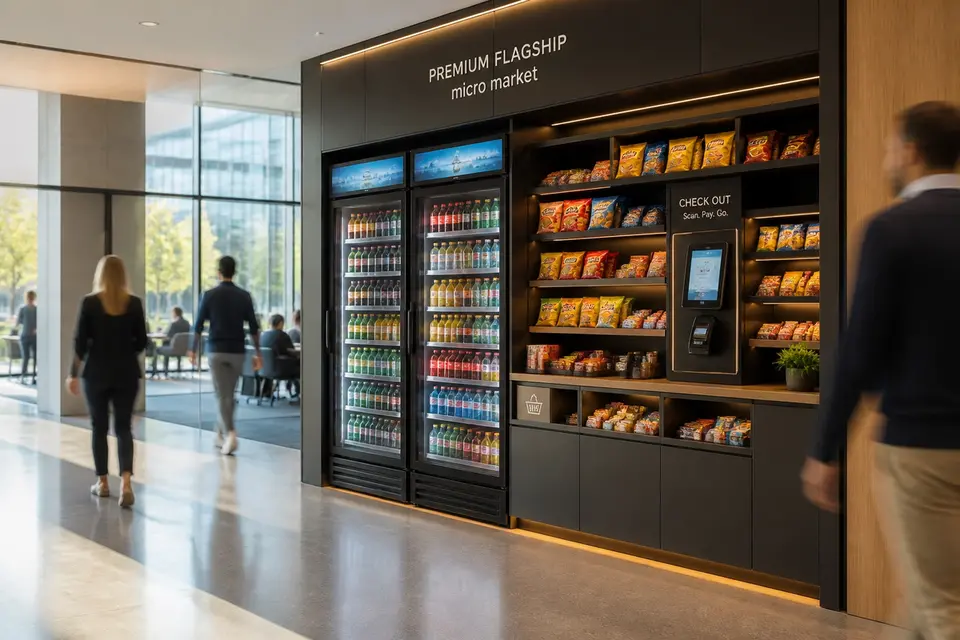
| Component | Lean Setup | Standard Professional | Premium Flagship |
|---|---|---|---|
| Kiosk & POS Hardware | $2,500 | $4,000 | $6,500 |
| Refrigeration (1-2 Units) | $3,500 | $6,000 | $9,000 |
| Shelving & Fixtures | $1,200 | $2,500 | $5,000 |
| Security & Cameras | $500 | $1,500 | $3,000 |
| Opening Inventory | $1,500 | $2,500 | $4,000 |
| Total Estimated Capex | $9,200 | $16,500 | $27,500+ |
1. The Self-Checkout Kiosk, The Heart of the Operation
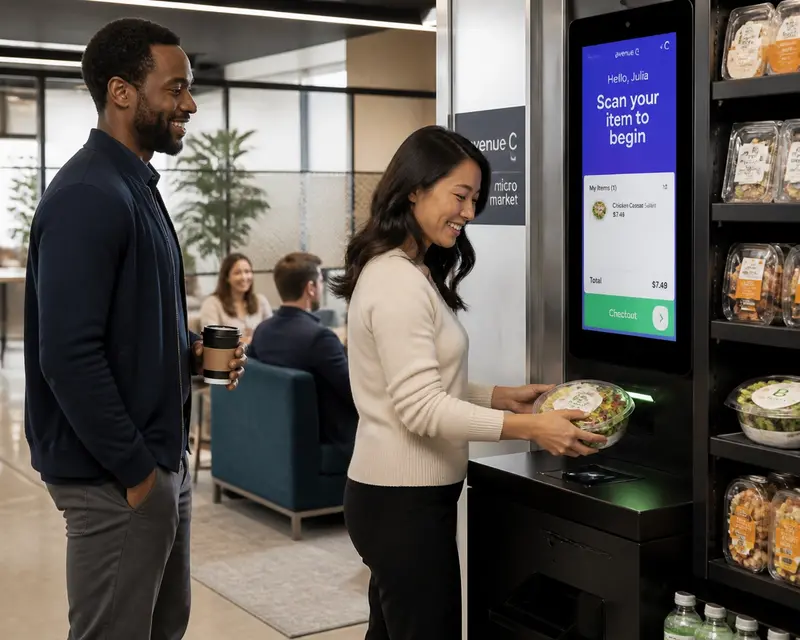
The kiosk is your most critical piece of equipment. Unlike a vending machine, which houses both the product and the payment system, a micro market separates them. Your kiosk must handle high-speed card processing, mobile wallets, and, increasingly, biometric or app-based logins for regular employees.
Expect to pay a monthly SaaS fee for the software, typically $50 to $150 per market, which covers the telemetry and remote monitoring. This data drives your day-to-day decisions, allowing you to use The Vending Club Operator Tools to optimize your inventory turns.
2. Refrigeration and Fresh Food Capacity
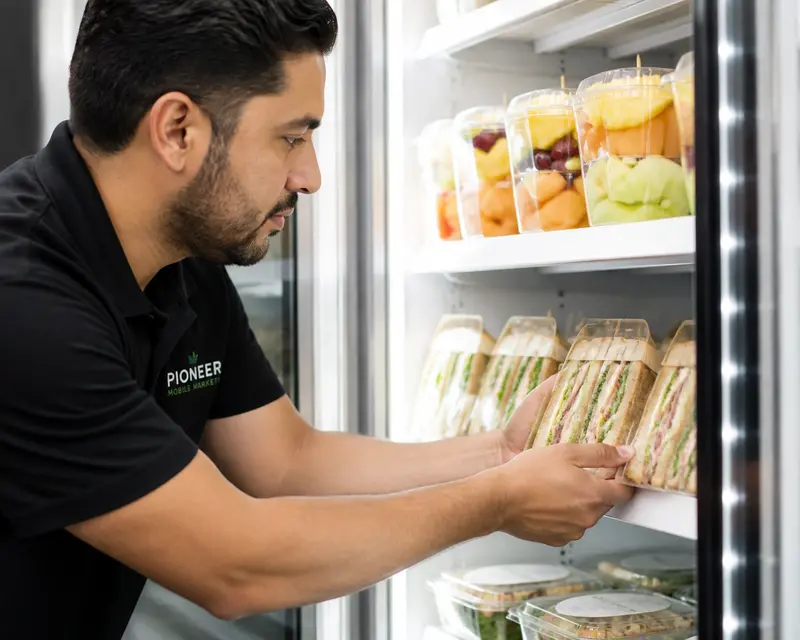
Fresh food is what makes micro markets profitable. Sandwiches, salads, and "better-for-you" meals carry higher margins and drive daily visits. This requires commercial-grade, health-lock-equipped coolers. If the power goes out or the temperature rises, the lock must engage to prevent foodborne illness, a standard liability requirement for 2026 operations.
3. Fixtures and Branding
A micro market is a retail store, not a machine. Custom millwork, branded backsplashes, and LED lighting aren't just "nice-to-haves", they are what allow you to command premium pricing. If your market looks like a gas station corner, employees will expect gas station prices. If it looks like a premium cafe, they will pay a premium.
Operational Costs, The "Invisible" Startup Expenses
Most operators fail because they budget for the equipment but forget the "float." Because a micro market holds significantly more inventory than a vending machine, your working capital needs to be much higher.
Opening Inventory and Product Mix
A traditional machine might take $300 to fill. A micro market, with its wide array of drinks, chips, fresh salads, and frozen entrees, requires $1,500 to $3,000 just to look "full" on day one. Running a market with empty shelves is the fastest way to kill adoption.
Insurance and Legal
Your liability changes when you move to an open-market format. You need specific riders for food spoilage and "theft" (shrinkage). Furthermore, your host agreement must be airtight. We recommend using professional Vending Contract Templates to define who is responsible for the electricity, internet, and security footage access.
🧮 Want to run your specific numbers? Use our Vending Profitability Calculator to model your route based on machine count, weekly sales, and costs.
ROI and Payback Periods, The Math Behind the Upgrade
Is the $20,000 investment worth it? Let's look at the payback period. In a high-traffic location, defined as 150+ daily users, a micro market should ideally pay for its equipment within 12 to 18 months.
The Revenue Model:
- Avg. Daily Users: 200
- Participation Rate: 40% (80 daily transactions)
- Average Ticket: $3.50 (inclusive of fresh food)
- Gross Daily Revenue: $280
- Weekly Revenue (5 Days): $1,400
- Annual Gross: $72,800
After accounting for Cost of Goods Sold (COGS) at roughly 45%, commissions (if applicable), and software fees, a single market can yield a net profit of $15,000 to $20,000 per year. This means your equipment is paid off in year one, and year two is pure cash flow.
The "Shrinkage" Factor, Managing the Downside
The biggest fear for traditional operators is theft. In an open market, there is nothing stopping someone from taking a sandwich without paying. In practice, operators in closed-loop environments (like a secure office building) typically report "shrinkage" between 2% and 4%.
To manage this, professional operators invest in high-definition NVR camera systems. The goal isn't necessarily to catch every "thief," but to create a "culture of accountability." Most kiosk software allows you to cross-reference sales with video timestamps, a feature that makes identifying discrepancies simple.
Launch Checklist for Vending Pros
- Secure the Site: Target locations with at least 125 employees and a "closed" campus (where people don't leave for lunch).
- Negotiate the Contract: Focus on exclusivity and internet access, avoid high commissions that eat your fresh food margins.
- Choose Your Technology: Select a kiosk provider that integrates with your current route management software.
- Plan the Layout: Use 3D rendering tools to show the host exactly how the market will transform their breakroom.
- Audit Your Supply Chain: Ensure you have access to fresh food distributors; relying solely on big-box retailers won't scale with a micro market.

Frequently Asked Questions
What is the minimum headcount for a micro market?
While some operators experiment with "nano markets" for 50 people, the industry standard for a full-scale micro market is 125 to 150 daily users to ensure inventory turns quickly enough to prevent fresh food spoilage.
Do I need to pay commission to the host?
In 2026, many operators are moving away from commissions for micro markets, citing the high cost of equipment and the "employee benefit" nature of the service. If you do pay, it is typically lower than traditional vending, often 5% to 10% of net sales.
How do I handle internet connectivity?
Most kiosks require a hardwired ethernet connection for security and speed. If the host won't provide one, you can use an industrial cellular router, though this adds to your monthly Opex.
Can I use used equipment for my first market?
Yes, but be cautious with refrigeration. Used coolers often lack the modern "health locks" required by many local health departments for fresh food. Always check local codes before buying refurbished units.
How often should I service a micro market?
Most high-volume markets require service two to three times a week. Because you are dealing with fresh food expiration dates, your service schedule must be more rigid than traditional snack vending.
Making the Move to Micro Markets
The transition from vending machines to micro markets is the difference between owning a "job" and owning a "retail business." By investing in the right equipment and systems today, you're positioning your route for the higher margins and greater scalability of the future.
Ready to start scouting? Post what you are looking for with Locations Wanted to hear from locators about your next high-traffic site and start building your 2026 micro market route.